Control Company Costs
What Does Good AP Visibility and Control Actually Look Like for ANZ Businesses — And How Do You Get There?
Key takeaways
- Manual AP processes create delays, errors, and limited visibility into spend and cash flow
- Fragmented systems make it difficult to track invoices, approvals, and compliance in real time
- AP automation improves invoice capture, approval workflows, and data accuracy
- Finance teams benefit from centralized visibility across invoices, suppliers, and approvals
- AI-powered tools like OCR and data intelligence reduce manual effort and improve reporting
- Successful AP transformation depends on change management, training, and stakeholder alignment
Why AP Visibility and Control Matter
In the face of growing transaction volumes and increased vendor expectations, finance teams must ensure a smooth and efficient accounts payable (AP) process to keep cash flow moving. But fragmented systems and manual invoice processing can slow things down, creating delays that weaken supplier relationships and make it difficult for organisations to forecast cash flow and meet compliance requirements.
So how can finance teams gain the real-time visibility and control they need to maximise AP efficiency?
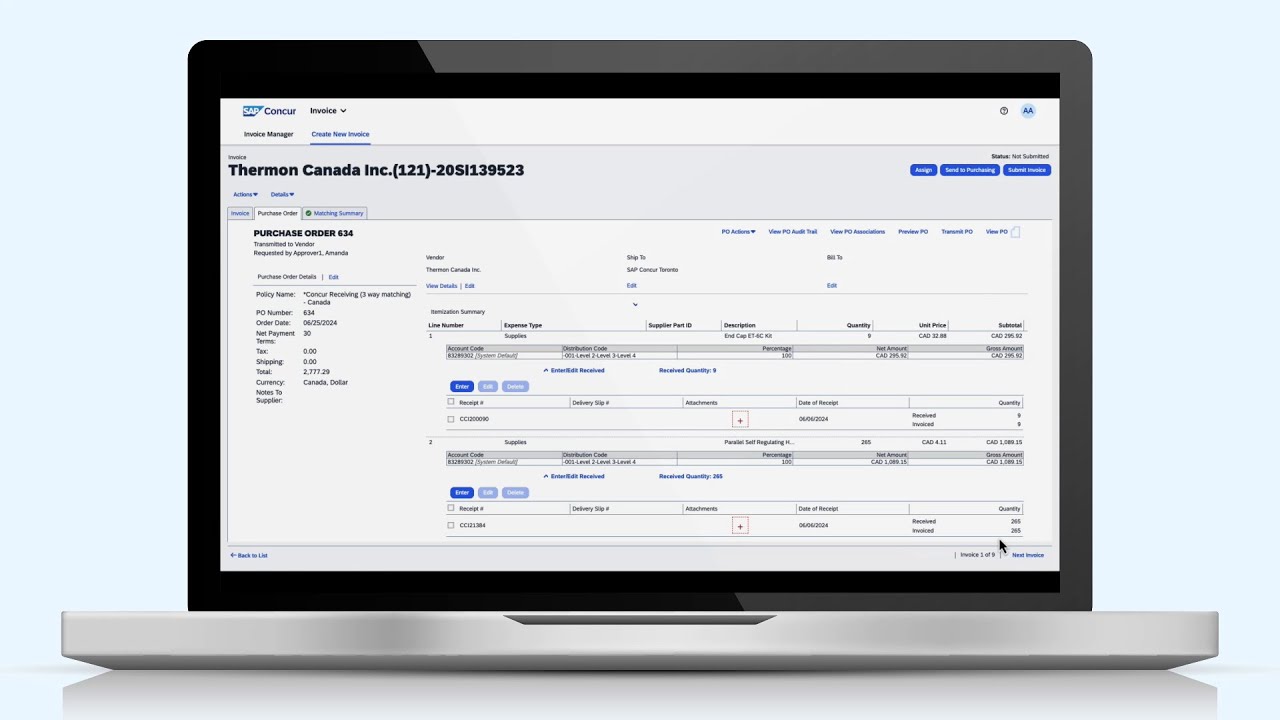
Concur Invoice automates and streamlines the entire invoice management process, from receipt to payment, enabling businesses to easily capture, submit and pay invoices with full visibility into business spend.
In 2026, Peter Soukos, Director Client Executive at SAP Concur, hosted a webinar to discuss the opportunities and challenges of rolling out Concur Invoice. He was joined by three customers – Maria Mash, Accounts Payable Team Leader, Engenco; Melanie Marshall, AP Officer, Newcastle Anglican; and Brendan Tanner, Head of Finance, McGrathNicol – who shared their experiences of how Concur Invoice has added efficiencies, as well as tips for managing the AP solution.

Online Customer Panel Unlocking Visibility and Control in AP: 3 Organisations Share Their Success Stories
If you have an AP solution and would like some ideas on how to optimise your own process, or if you are thinking of digitising your AP process, watch us now and hear firsthand how three finance leaders are using Concur Invoice to add efficiencies to their business.
They will share their own experiences and tips for automating their Accounts Payable function, including tips for implementing and configuring a new AP system, considerations for change management and training, and the most impactful ways a solution like Concur Invoice can help your AP process.
Still Processing Invoices Manually? Here’s What ANZ Finance Leaders Are Doing Instead
Before implementing Concur Invoice, all three organisations — McGrathNicol, Engenco, and Newcastle Anglican — were facing similar AP challenges that led them to automation.
Before implementing Concur Invoice, McGrathNicol, Engenco, and Newcastle Anglican were all facing common AP challenges that led them to automation.
McGrathNicol (Brendan Tanner, Head of Finance):
- Invoices arriving via email and paper with limited visibility across approvals
- Invoices sitting in approval workflows with no end-to-end tracking
- Manual GST coding by non-finance staff leading to errors and inconsistencies
- Difficult corrections in legacy AP systems
Engenco (Maria Mash, Accounts Payable Team Leader):
- Slow invoice processing and delayed approvals
- OCR failing to capture full invoice data
- Workflows getting stuck in approval queues
- Frequent system disruptions due to single sign-on failures
- API integration issues and security concerns
“Without full visibility over the process, invoices were sitting in the approval flows,” Brendan said.
When choosing a solution, McGrathNicol had one non-negotiable: automation. Brendan said, “We were looking to remove that manual keying aspect to reduce errors, so we needed to automate at least part of the process. We wanted to incrementally improve anything we possibly could. Once we became aware of Concur Invoice, we could quickly see how those pain points would be addressed.”
Engenco had already been using Concur Expense to streamline and automate the management of employee expenses. Implementing Concur Invoice was the logical next step in their digital transformation. “We know how well Concur Expense works; we’ve never had any issue with it,” Maria said. “So Concur Invoice was our next port of call.”
| Manual AP processes | Automated AP processes |
|---|---|
| - Invoice data entered manually | - Automated invoice capture and data extraction |
| - Invoices received across email, paper, and systems | - Centralised invoice intake and processing |
| - Limited visibility into approval status | - Real-time visibility across invoice lifecycle |
| - Higher risk of human error (e.g. GST coding) | - Improved accuracy through automation and validation |
| - Delayed approvals and bottlenecks | - Streamlined workflows and faster approvals |
| - Difficult to correct errors after submission | - Easier correction and standardised workflows |
| - Heavy reliance on IT and manual intervention | - Finance-led management with minimal IT support |
| - Limited reporting and insights | - Built-in reporting and spend visibility dashboards |
How ANZ Businesses Are Implementing AP Automation Without Disrupting Day-to-Day Operations
Once Engenco and McGrathNicol had decided on the Concur Invoice solution, they were pleased to find that implementation was quick and relatively seamless. While there is always some complexity in integration systems and APIs, with the assistance from SAP Concur support teams, day-to-day operations continued to run smoothly during the transition.
Brendan said, “We’re now five years post go live but I remember the implementation for Concur Invoice as being reasonably painless. We had a couple of internal resources that were responsible for it, but they didn’t have to be dedicated in any way. It was a kind of fractional responsibility where they were doing their day job as well.”
In addition to the SAP Concur team, McGrathNicol leaned on external support for integration with the broader ERP program. “We were implementing the ERP at the same time as the AP solution so both sides were moving – that was probably the most challenging part,” Brendan said. “The rest was straightforward: building the workflows we wanted, that weren’t exactly the same as what we had previously, and all the approval steps. I don’t think we would have done anything differently.”
Engenco (with SAP partner Xaana) and McGrathNicol both implemented Concur Invoice with a focus on phased delivery and minimal disruption.
Key implementation highlights:
Engenco (Maria Mash, Accounts Payable Team Leader)
- Worked with Xaana to accelerate design, invoice capture, and master data cleanup
- Managed differing PO matching rules across business units
- Prioritised Phase 1: invoice capture, PO/non-PO processing, and approval chains
- "Improved straight-through processing rates for PO matching
- Enabled real-time ERP data flow through structured data consolidation
McGrathNicol (Brendan Tanner, Head of Finance)
- Implemented Concur Invoice alongside ERP transformation
- Built new workflows and approval steps during rollout
- Maintained business-as-usual operations with fractional internal resources
“Overall, our experience was really excellent,” Maria said.
The ANZ Finance Leader’s Playbook for Rolling Out AP Automation Across Your Organisation
A major barrier to successful deployment of a new tech solution is end user adoption. Fortunately, Engenco and McGrathNicol had a clear strategy to communicate the value of Concur Invoice, driving early uptake.
Brendan said, “As part of our broader ERP deployment, we had an extended communications plan covering a whole range of topics – the AP change was part of that. We shared granular detail with the administrators across the country about a month before we went live, so they had plenty of heads up for what was coming. A few of those team members were involved all the way through, helping with design and providing key user input at different points.”
And while training was an important component, the emphasis was on drilling the basics rather than overwhelming the team with information overload. Brendan said, “For this particular one, we aimed not to overtrain our admin team but just focus on the key changes: how to get an invoice into Concur, assign project codes, and select approvers. We reinforced the new workflow process, that there was going to be a verification step for finance personnel upfront that would take away some of the data points they were previously responsible for, like GST.”
McGrathNicol offered a one-hour workshop for all staff a couple of weeks before deployment, then optional training about a week later. “I can’t recall anyone actually attending,” Brendan said. “This probably highlights how poor our previous process was, because once they got into the new system and did a couple of invoices, they didn’t need a great deal of training – just some refinements and sharing extra features.”
Because the platform was so easy to use, the team quickly understood the benefits. “This was one of the most positively received aspects of the broader transformation project we were running – that ‘less is more’ training approach really worked well for us. Most of our team found the platform pretty intuitive,” Brendan said.
Because Engenco already used Concur Expense, adoption of Concur Invoice was straightforward.
Engenco (Maria Mash, Accounts Payable Team Leader) training approach:
- Rolled out training starting with approvers to secure early buy-in
- Delivered three short (30-minute) training sessions for users
- Provided cheat sheets and quick reference guides
- Set up a support channel for ongoing questions
- Worked closely with procurement for early feedback and alignment
“Overall, it was a very simple implementation and training program across the company,” Maria said.
Less Manual Checking, Fewer Errors: How AP Automation Is Transforming Daily Finance Operations in ANZ
At Newcastle Anglican, Concur Invoice is an integral part of daily operations. Melanie said, “We’ve got most of our suppliers sending invoices directly through to Concur now. We just get the odd ones that are still a bit old school and email them through to us and we’ll just forward them on from there.”
Newcastle Anglican (Melanie Marshall, AP Officer) described a streamlined AP workflow using Concur Invoice:
- Automatic invoice capture and verification routing
- Multi-page invoice separation handled automatically
- OCR extraction of key invoice data
- Simple assignment of staff names for approval routing
- Validation of expense type and invoice details before submission
“We just hit ‘submit’ and off it goes to them,” Melanie said.
For Melanie and her team, the system maximises both efficiency and accuracy, although there are the occasional anomalies that require a human in the loop. She explained, “The only other instance is when there are both GST and GST-free items on the same invoice. In that case, we have to assign the invoice to ourselves so we can do the GST split and go to the next. So we work with it.”
Clear Governance, Low Maintenance: An AP System That Supports ANZ Finance Teams
When it comes to ongoing upkeep of the solution, the good news is that Concur Invoice doesn’t require heavy IT involvement. The finance team is able to take ownership almost entirely, saving a lot of time, effort, and complexity.
Newcastle Anglican (Melanie Marshall, AP Officer) uses Concur Invoice for supplier data management and housekeeping:
- Exporting supplier reports into Excel
- Filtering suppliers by usage history
- Flagging inactive suppliers to reduce risk
- Re-uploading cleaned supplier data into the system
“It’s great that you can download a report to Excel, filter it however you want, and check when you last used a supplier,” Melanie said.
Brendan agreed that the finance team at McGrathNicol is across the day-to-day aspects of system admin and maintenance of the user base. He said, “Whether it’s different access levels within Concur, we’re looking at features that could be used by other people in the firm – that very much sits with finance.”
This frees up the IT team to focus on the more complex task of monitoring integration points. Brendan said, “Our supply master sits in our ERP and we’re moving that data across on a nightly basis. Any new suppliers that are integrated come across to Concur, and equally all of those supplier invoice details come back to the ERP for payments. But once the system is deployed, it’s not a heavy IT team requirement – how it’s used is driven by the finance team.”
Engenco’s finance team also owns maintenance of the Concur solution, Maria said. “Someone in head office finance handles the expense module and I handle the load for invoicing, with Xaana as our remediation contact. The only time we would get our internal IT involved is if there was a certificate issue – for example, tickets haven’t been renewed.
“But if we’ve got the ERP flowing, it’s happening in real time. That data is forever changing; if anything isn’t populating, Xaana will re-import or export what we need it to do, so that is the only thing we’re really touching. For anything else, like setting up new users, it’s all managed in-house in finance.”
How ANZ Finance Teams Are Using AI and Machine Learning to Transform Accounts Payable
SAP Concur solutions use AI and machine learning to streamline accounts payable processes and improve accuracy across invoice workflows.
Key AI capabilities include:
- Intelligent invoice matching to reduce manual processing
- Optical Character Recognition (OCR) for automated data capture
- Faster invoice processing and reduced human error
- Continuous improvement in capture accuracy over time
Brendan Tanner, Head of Finance at McGrathNicol, said OCR performance exceeded expectations: “We were promised it would be 80-85% accurate… but we’ve found it to be far more accurate than that right from day one.” Concur Invoice also provides embedded Business Intelligence tools that turn AP data into actionable insights for finance teams.
Key reporting capabilities include:
- Customisable dashboards and reports
- PO and non-PO invoice tracking
- Supplier spend visibility down to coding level
- Exception tracking and audit support
- Data-driven insights for supply chain collaboration
Maria Mash, Accounts Payable Team Leader at Engenco, said: “I’ve got about 15 reports I can pull into a dashboard… we can show exactly where the money’s going – down to the supplier, money spent, codings, exceptions, the whole lot.”
Because these tools have enhanced visibility and reduced manual effort, SAP Concur customers are excited to leverage future AI capabilities. Brendan said, “SAP Concur’s AI features are very well-liked and received at McGrathNicol. Due to the nature of a services firm, there are other elements that we don’t utilise but if we can get to the point where we need more generative AI built in for verification and assigning to our approvers, I’ll happily accept it.”
From Dashboard Visibility to Mobile Approvals: The AP Benefits ANZ Finance Teams Rate Most Highly
After several years using Concur Invoice, Newcastle Anglican, Engenco, and McGrathNicol highlighted a consistent set of benefits that have become central to their AP operations.
Newcastle Anglican (Melanie Marshall, AP Officer)
Key benefits:
- Easier sorting and prioritisation of verification workloads
- Faster processing of high invoice volumes
- Strong usability compared to legacy systems
- Simple navigation and quick reassignment of invoices
Melanie said the verification workflow has been a major improvement: “We could have 400 items in there; not all of them are verifications… I always sort by verifications, then click on the date and time it was received so I can process the oldest first. That’s huge for me.”
She also highlighted the ease of use: “It’s very simple to use, there’s not a lot of thinking… you just tab through all the fields… and it’s a simple two-step click to get it to the right person.”
McGrathNicol (Brendan Tanner, Head of Finance)
Key benefits:
- Real-time visibility across invoice workflows
- Clear overview of invoice status via dashboards
- Flexible workflow design during implementation
- Mobile-enabled approvals via the Concur app
Brendan highlighted the value of visibility: “It’s just really easy to visualise where everything is in the process… it gives a clear picture of the entirety of your invoice volume at that point in time.”
He also called out flexibility as a long-term advantage: “The flexibility we found with the tool is what makes us still think it was a really good decision all these years later.”
And on mobile approvals: “Approvers can just use the Concur app on their phone. It’s a very modern experience.”
Engenco (Maria Mash, Accounts Payable Team Leader)
Key benefits:
- Single, unified view of invoice exceptions
- Improved transparency across matching processes
- Better visibility into why invoices do not auto-clear
Maria emphasised the importance of visibility into exceptions: “It’s given us greater visibility. We can see all the exceptions and why things aren’t going straight through the three-way matching we have on our POS.”
ANZ Finance Leaders Share Their Top Advice for Starting an AP Automation Journey
1. Start with a clear understanding of your current process
For Maria Mash (Engenco, Accounts Payable Team Leader), success starts with deeply understanding existing processes and aligning stakeholders.
- Understand your BAU processes end-to-end
- Identify key AP pain points before implementation
- Align AP and procurement teams early in the process
She said: “Know your BAU back to front including what pain points you need to address. Make sure you’ve got buy in from procurement from the AP side, so that you’re working together to get the right solution.”
2. Use specialist support to unlock quick wins
Maria also highlighted the value of working closely with Concur’s Premium Assistant team to resolve complex issues quickly.
- Leverage expert support for configuration challenges
- Address ERP limitations and exception handling issues
- Improve accuracy in financial processing and matching
She said: “One change gave us an 80% improvement… the Premium Assistant team can fix that up straight away and bam, huge benefit for us.”
She added: “Now I’m able to show the pain point to our Premium Assistant and ask, have you got a solution for this?”
3. Build automation and AI into your transformation strategy
For Brendan Tanner (McGrathNicol, Head of Finance), automation and AI are essential foundations of modern AP transformation.
- Prioritise automation and AI-enabled workflows
- Avoid replicating old processes in new systems
- Focus on adopting improved solutions, not legacy thinking
He said: “Any AP transformations need to have that as a key component; certainly Concur Invoice has automation and AI features built in.”
And added: “Don’t just stick with what you currently do – find a new solution.”
4. Design for long-term flexibility, not just go-live
Brendan also stressed the importance of thinking beyond implementation and designing for future scalability.
- Align AP transformation with long-term strategy
- Build flexibility into workflows from the start
- Use implementation as a chance to rethink processes
He said: “Take the opportunity with any transformation to rethink what you’re doing… you can almost turbocharge that automation off the back of it by making sure you’ve got your future state workflows and flexibility built into the solution.”
Final takeaway
A well-designed AP transformation can significantly improve business performance by reducing manual effort and increasing financial control.
By automating and streamlining accounts payable, Concur Invoice helps finance teams gain real-time visibility over spending, enabling more efficient, data-driven decision-making and stronger operational outcomes.
FAQs